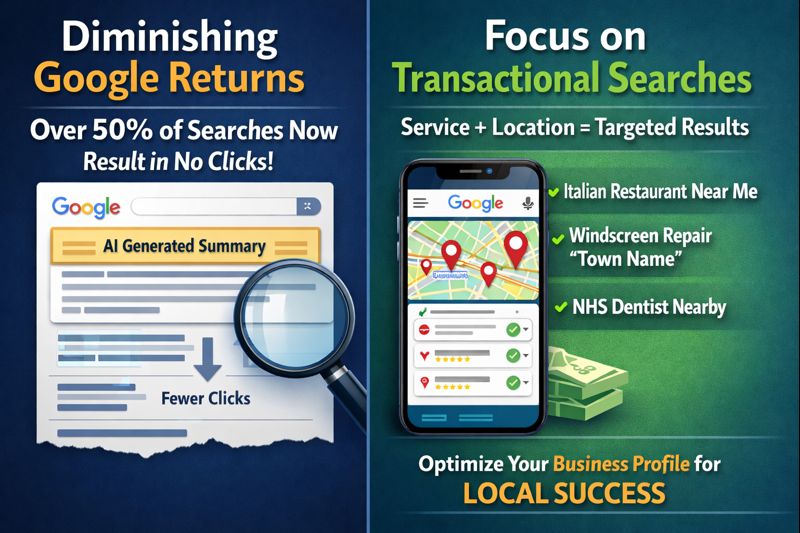
Over half of Google searches now no longer result in a click to any website! 👉Why? As the AI summary meets the needs of the person searching there is invariably no need to search further and find an individual website. Impressions for the top organic results may still look good as those results show on the right-hand side of the search results page, but the click throughs are down as the needs of the searcher are already met from the detailed AI summaries.
👉Can you combat this fall in clickthrough to your website? Yes, you just need to understand where Google now delivers you the best results and this is no longer information searches based on questions such as: 💠How can I change a tap washer? 💠What are the best ways to insulate old properties? 💠Do I need a solicitor to manage my conveyancing?
Resulting pages will have few, if any organic listings. These searches will largely be met with an AI response and paid ads – over 50% result in no clicks.
Transactional searches however are where your bounty can be found; searches based on a service and a location will yield good, targeted results in Google Maps, especially on mobile results.
Examples of Transactional searches: 💠Italian restaurants new me 💠Windscreen repair in “town name” 💠NHS Dentist with parking near me
These are specific searches and will be met with a Google Map and then a listing of suitable LOCAL and RELEVANT providers.
Key to being favoured in these results is ensuring that your Business Profile Listings are complete and verified. The bare minimum information should include company name, contact information, your Google Review Rating, directions to find you and a link to your website. There is so much to cover on actively managing your business profile for this post, however this is where you can lift your profile in the search results over others by maintaining it well and regularly.
All this assumes your website is technically healthy, which is another discussion altogether.
Have you shifted your search mindset to this new reality?
Whatever the project ahead we need clarity
and you need to know you’ve got the right team to deliver on what you want to
achieve.
Before every new client engagement for a sales and marketing web development, we’d like to actually find out who you are, what makes you tick, and why your customers buy you. This way we can make certain that anything we produce, be it a website, social media program, blog program, or alike meets your expectations and those of your clients.
We’d like to start with your vision and
mission statement.
Your Vision is saying what you want
for to the world,
and
Your mission statement is how
you’re going to present yourself and interact with the world.
Then we know you!
With that understanding we’ll move on to understanding
your brand manual. We come across many who have no brand guidance in place which makes it
difficult to project the business in a consistent and accurate manner;
essential for consistent sustainable growth. Your brand guidance will include
amongstother items:
your visual identity,
your colour palette,
the fonts that represent your business,
your logo
logo usage guidelines
your strapline
the tone of voice and the positioning so copy is consistent
Positioning – How you are seen as in the world for instance are these part of the company’s mantra:
Being charitable
Innovative
Creative
Ecological
Sustainability
Community focused
If there is no brand manual in place we will need time to understand these item
with you before we start the project. Many clients have us complete this
formative work with them as a mini project before the main project; thus “putting
in firm footings”.
Given all the above items that shout to the world who you are and why the
readers need to take notice, we’ll have a good idea of what makes you special
so we can make you look the
best “you” you can be online
“Customers in the past, have said, ‘you’re a little bit different to the others’.
Alleluia!
Well, this may or may not be the case.
But what does resonate with us is that we take the time to understand who you
are, and what makes you the best at what you do. Then with that knowledge,
we’re armed with all we need to make you look good to everybody else.
Frankly, it’s pointless leaping into a
program of building a website, running a marketing campaign for you, writing
your social media, engaging with your social media audience on your behalf,
writing blogs for you, or doing creative
branding if all of this is on weak ground if we don’t know who you are, and
what makes you good.
So the first questions with any new engagement
with Toucan Internet is
Yesterday I had an urgent call from a good client who needed advice on a domain name that was being offered to them. This domain name was reportedly ranking highly with Google as it was made up from a combination of generic product and location terms, such as interior-design-london.co.uk.
Domain Scams
The first thing to consider is that in a by gone era exact
match domain names positively impacted search results, whereas now the Google
Algorithm is much more mature, and the impact is negligible if not negative. My
message today is if you want quality results then have a quality website from
all key aspects; content, user value and technically.
The vendors of these “unmissable” domains will normally say
that there is someone else or a client interested but they are offering it to
you for some reason – who would ever commission such a company when they’ll
offer the domain to your competition; that just does not stack up.
As with any purchase you need a degree of due diligence, the
empirical evidence of relevant visitors to a domain name is a must; you are in
a similar way when buying a business, buying the customer list. Remember a
website that is ranking well one month may not do so well the next as rules
change. Furthermore, if the website has been closed for a while and it’s just
the domain name that’s available, Google will start to clear it from the
results as it has no pages to index and also the third-party backlinks will
diminish over time. Effectively there is a half-life of a domain name when it
has no associated website as it’s SERPS
value diminishes over time.
https://www.whois.net/
will give you some basic data, importantly it will give you the date of
registration, then if you’re being offered a domain that was registered
recently, you know it’s a scam as it would have had little time to gather a presence.
The performance data can be hard to interpret but should give you an
indication.
My recommendation is to follow your inner compass on such
matters and not be brow beaten into taking an unmissable offer because you’re concerned
that you’re missing out; trust me most are miss’able.
Additionally, if the domain is offered at say £700, also consider
what value you could buy your business with that money such as paid advertising
clicks or professional social media content and engagement.
For my clients I’m always available to assist with any such
decision making and welcome your calls.
———————-
Simon Thomas has 40 years’ experience in business practices
and builds & programs bespoke websites and apps that sell, market and
automate processes.
“My kick is seeing the business wheels spin more efficiently once we’ve done the geeky process stuff”.
When was the last time
you stood back and looked at the workflows in your business? Why should you if
everything is working well; orders are coming in, the system is processing them
and the goods and services are going out?
The simple reason is
that we live in an environment where technology, convergence and innovation are
opening up new opportunities for everyone, especially businesses, and giving us
further tools and resources to achieve more. OK it’s easy to get overload at
this point with the opportunities to do things differently are everywhere and we
can also be seduced by the next new shiny toy, be that hardware or an app.
Cleverly you need to continually
ensure your business assesses what resources it needs to grow and remain
efficient; what you did last year may not be the best this year; and if you
were doing it five years ago you’re likely missing a benefit somewhere.
We routinely see
businesses processing data and products where big leaps in efficiency could be
gained through the automation of workflow and processes. There are some very
simple changes where automation apps can be included behind the website. Some
businesses will have started and developed workflows using spreadsheets, which
to my mind is excellent as you’ve got a tool that everyone knows how to use at
a fundamental level and changes can be made quickly and with little overhead.
However when the
processes are proven and mature, rarely is a basic spreadsheet the most efficient
way. Use spreadsheets as breadboards for building and honing the process and
then get the processes automated. The automation will remove human error and
save significant labour costs. Then with the freed-up labour turn it to greater
profitability, therefore growing your
business not your payroll.
Having your staff,
customers and processes on one common platform makes for significant innovative
opportunities for growth.
Simon Thomas has 40
years’ experience in business process and builds & programs bespoke
websites and apps that sell, market and automate
processes. “My kick is seeing the business wheels spin more freely once we’ve
done the geeky stuff”.
More and more businesses are getting in contact regarding Cyber liability insurance, there is a great deal of interest about this particular risk, however there is also a great deal of misconception regarding the cover available.
Senior managers in three-quarters (73%) of micro/small businesses say that cyber security is a high priority, with over two-fifths (45%) of all micro/small businesses having identified a cyber security breach or attack in the last year. Of the micro/small businesses that consider it a low priority, over a third (35%) have nonetheless identified a breach.
“over two-fifths (45%) of all micro/small businesses having identified a cyber security breach or attack in the last year. “
As an independent broker we are best placed to advise on a number of different policy types and cover limits available to the business community, however the biggest problem to-date is that most businesses will assume that they already have cover in force, when in fact they don’t.
Cyber liability will be a general exclusion for most, if not all business insurance policies and with the advent of the new “General Data Protection Regulations” (GDPR), I would advise any business, large or small to review their insurance arrangements.
Currently there is very little penetration within the SME market place for Cyber liability insurance, however it is exactly those businesses that are at greater risk.
Cyber liability insurance can protect you and your business including employees (1st party) and your supplier and customer chain(3rd party) in the event that you experience a data breach and it is not only restricted to malicious events, accidental data loss can also be included.
Whilst there are restrictions and limitations for social engineering or invoice fraud, this would be considered financial crime, the Cyber liability cover is there to protect your reputation and any costs associated with getting your business back to normal following a “breach” including consequential loss.
Think of it as an “emergency red button response”, so that whilst someone else will contain the breach and manage the fall-out, you continue to run your business with limited impact.
Toucan Internet have been assisting clients in Cyberspace since 1997 and continue to advise, support and inform on online matters in the bigger field of digital awareness and empowerment.
What if
your online reputation was sullied by association with pornography and the more
seedy side of the Internet? Then compound that with being practically helpless
to correct it.
To survive
in modern business, we all strive to build a reputation that emphasises who we
are and the values we hold dear. Our reputations are extensions of us online and
influence whether people choose to engage with us or not. No matter what size
of enterprise you are, your online reputation will influence your success in
one direction or another.
Consider a
business called “XYZ Enterprises PLC” and over the years they’ve gathered
domain names in their portfolio for the main business, for niche marketing and
for sub divisions. They make the pragmatic decision that a largely unused
domain with an old website such at www.xyzenterprise.tel is no
longer of any use so it’s not renewed.
The domain
then expires after the registration period is over and it goes into a grace
period of 0 to 405 days followed by a redemption period of between 14 to 30
days. After that it goes into the public pool again and anybody can register it
for themselves.
Consider
the dismay when the owners of XYZ Enterprises PLC see that www.xyzenterprise.tel
is now a gateway site into a porn-hub, furthermore it’s now registered in
Russia so a polite “cease and desist” is not really going to have the desired
effect.
The new
owner is using the good standing and following of XYZ Enterprises’ old domain
to drive visitors to this illicit website. They’ll probably be open to a large
Bitcoin deposit from you to relinquish ownership or you may choose to address
this via the registrar for remedial action on the grounds of cybersquatting or
abuse. I’d not hold out too much hope for a result.
The moral
of the story is to play safe, renew your domains that clearly point back to you
and don’t get in to a pickle in the first place.
About the
author
Simon Thomas is a founding
partner of Toucan Internet LLP; making a difference for clients looking for
greater and unexpected outcomes from their digital engagement.
Toucan Internet have been custodians
of clients’ domain portfolios since 1997 and understand the intrinsic value of
“keeping your nose” clean online.
SSL Certificates provide secure, encrypted communications
between a website and an internet browser. SSL stands for Secure Sockets Layer,
the protocol which provides the encryption. SSL Certificates are typically
installed on pages or whole websites that require end-users to submit sensitive
information over the internet such as personal data, credit card details and passwords.
Pages such as payment pages, online forms and login pages should have SSL
encryption.
Why Do I Need an SSL Certificate?
Data transferred in non-encrypted format can be intercepted
between you and the webserver such that your communication and the data therein
could be compromised and stolen. Online transactions may involve sending personal
information such as credit card information, social security numbers, usernames
and passwords. Cybercriminals who intercept unencrypted communications will
gain full access to this data and can use it for fraudulent activities
including identity theft and purchases.
Trust and security are what make people confident enough to
provide private or sensitive information online. SSL certificates demonstrates
that a website or web page can be trusted. Any organisation must use an SSL
certificate to secure their site if they wish to take online payments or expect
their visitors to submit confidential information. Apart from building
essential trust and security into your website, SSL certificates also help with
SEO efforts as Google rates the use of an SSL as a positive ranking indicator.
SSL Products Overview
All SSL certificates are typically a
combination of a Validation Level and Type.
Certificate Validation Levels
Extended Validated Certificates:
EV certificates provide the highest levels of security,
trust and customer confidence for online businesses. EV certificates are issued
only after the issuing Certificate Authority has conducted rigorous background
checks on the company according to the guidelines laid out by the Certificate
Authority/Browser (CA/B) Forum. Because of this, EV certificates contain a
unique differentiator designed to clearly communicate the trustworthiness of
the website to its visitors. Whenever somebody visits a website that uses an EV
certificate, the address bar will turn green in major browsers such as Internet
Explorer and Firefox however Chrome have dropped this pointing out that safe
websites should be the norm on the internet. EV certificates are used by all
major online retailers and banks and are highly recommended for businesses that
wish to immediately build customer trust in their site. The browser address bar
will include the company name with most popular browsers.
Organisation Validated Certificates:
OV certificates include full business and company validation
from a certificate authority using their established and accepted manual
vetting processes. Each OV certificate contains full company name and address
details, which means they provide significantly higher levels of assurance to
end-users than Domain Validated certificates. However, because they are not
validated to the CA/B forum standards, they do not possess the ability to turn
the browser address bar green.
Domain Validated Certificates:
DV certificates provide the same high levels of data
encryption as the other validation levels however do not provide assurance
about the identity of the business behind the website. Whereas EV and OV
certificates are only issued after the applicant organisation has been manually
vetted by a Certificate Authority, DV certificates are issued after domain control
has been established using an automated online process. DV certificates are a
popular choice amongst small-medium sized web sites because of their faster
issuance times and lower price points.
Free Non-Validated Certificates:
FNV certificates are only available to Toucan Internet LLP
clients and provide the same high levels of data encryption between the website
and browser. There is no validation on the domain or the organisation but will
engender trust with website users and assist as a positive ranking signal to
Google. These have some value however any enterprise should consider a DV certificate
as a minimum.
Certificate Types
Single
Domain Certificates
A single domain certificate allows a customer to secure one
Fully Qualified Domain Name on a single certificate. For example, a certificate
purchased for www.domain.com will allow customers to secure any and all pages
on www.domain.com. Single domain certificates are available in DV, OV,EV and
FNV variants at a variety of price points and warranty levels. The
straightforward nature of the single domain certificate makes it ideal for
small to medium sized businesses managing a limited number of websites.
However, businesses that operate or anticipate operating multiple websites may
benefit from the added flexibility, convenience and savings offered by wildcard
or multi-domain certificates.
Wildcard SSL Certificate
A Wildcard certificates allows businesses to secure a single
domain and unlimited sub-domains of that domain. For example, a wildcard
certificate for ‘*.domain.com’ could also be used to secure
‘payments.domain.com’, ‘login.domain.com, ‘anything-else.domain.com’ etc. A
wildcard certificate will automatically secure any sub-domains that a business
adds in the future. They also help simplify management processes by reducing
the number of certificates that need to be tracked. For growing online
businesses, Wildcard certificates provide a flexible, cost effective
alternative to multiple single certificate purchases.
Multi Domain SSL Certificate (MDC)
As the name suggests, a Multi-Domain certificate allows
website owners to secure multiple, distinct domains on a one certificate. For
example, a single MDC can be used to secure domain-1.com, domain-2.com,
domain-3.co.uk, domain-4.net and so on. Indeed, an MDC will allow you to secure
up to 100 different domains (or wildcard domains) on a single certificate.
Customers can easily add or remove domains at any time. This simplifies SSL
management because administrators need only keep track of a single certificate
with a unified expiry date for all domains instead of keeping tabs on multiple
certificates. In addition, MDCs usually represent a cost saving over the price
of individual certificates.
Unified Communications Certificate (UCC)
Unified Communications Certificates are specifically
designed to secure Microsoft® Exchange and Office Communications environments.
UC certificates use the Subject Alternative Name (SAN) field to allow customers
to include up to 100 domains on a single certificate – eliminating the need for
different IP addresses per website that would be required otherwise. UC
Certificates also support the Microsoft Exchange Autodiscover service, a
powerful feature which greatly eases client administration. As with MDCs, a
single UCC can greatly reduce SSL management duties while allowing customers to
realise cost savings over individual purchases.
Simon Thomas is a founding partner of
Toucan Internet LLP; making a difference for clients looking for greater and
unexpected outcomes from their digital engagement.
About the author
“Guidance like this is important to our clients when we
provide SSL’s for websites and web apps that Toucan Internet has developed.”
Simon also has 20 years direct
marketing experience pre-internet and provides a unique blend of innovative
advice based on experience and an informed understanding of today’s and
tomorrow’s enabling technologies.
Am I alone in thinking that the upgrade treadmill we find ourselves on with cutting edge tech devices is somewhat irksome? Sure, we all love the latest gadget or upgrade that is so seductively packaged with new features such that your life just won’t be complete without it. Then before you realise, you to have bitten the bullet and bought into yet another next upgrade step.
Additionally, with the trend for manufacturers to seal products there’s little opportunity for us to gain access for repair. Even with the most nimblest of hands, even changing a smartphone battery becomes an impractical feat for most of us. This puts the control firmly in the hands of the manufacturers who are continuously innovating the next must have device.
If lifecycles for devices could be increased by the ability to repair them and the lengthening of the upgrade cycle, then in the instance of smartphones if these had a life of 4 years, the impact of resourcing, mining and production would be halved; that’s one sizeable global environmental impact.
Countering the trend of irreparable smart phones is Fairphone (https://www.fairphone.com/en/), built with ethically sourced materials, available with open source repair manuals and even repairable with 3D printable components. Maybe the planet and us consumers would both be better off if other leading smartphone manufacturers took the bold step and adopted this more people and earth friendly business model?
Article inspired by PC Pro’s Dan Stevenson ‘fixing the unfixable’.
About the Author
Simon Thomas is a founding partner of Toucan Internet LLP, making a difference for clients looking for greater and unexpected outcomes from their digital engagement. Simon also has 20 years direct marketing experience pre-internet and provides a unique blend of innovative advice based on experience and an informed understanding of today’s and tomorrow’s technologies.
Now that everything and everyone is online, we live in a world of information overload. Getting people’s attention is harder than ever. With so much access to choice and knowledge, customers are taking their purchase journey online, where the influence of salespeople matters less and less.
The good news is there’s still a way to sell online. It takes a new approach and great tact. The online environment has a short attention span but a long memory, so making certain mistakes will cost you dearly. Make sure you avoid these five selling mistakes:
1. Regurgitating obvious information – Before we all went online, prospects needed someone to explain products or services. Now they can find this information online by themselves. Salespeople have to provide something more, giving new insight that sparks that Aha! moment in a prospect’s mind. That’s the best way to avoid being seen as just an opportunist, an order-taker, or entirely unnecessary to the buying process.
2. Looking for leads behind a door – We still need to go where the customers are. But gone are the days of knocking on a door and being welcomed for your information. Same with cold calls. Customers are not waiting for the phone to ring. They’re online, doing their own searches and spending time on social media. To nurture prospects as response rates dwindle, forget doors and phones — and head online. It’s a different allocation of time and energy, but vital to selling in the digital arena.
3. Using an antique selling model – The traditional purchase funnel is 120 years old. It was widest on top to fit in an enormous volume of prospects, tapered down through the attention phase, and then out popped enough sales to make the effort worthwhile. The digital sales funnel is altogether different. It’s not funnel-shaped, but widest in the middle. Attention is today’s rare commodity, so the longer we can contain it, with insights and other added value, the better the chance of influencing people’s buying decisions.
Waiting for face-to-face to build a reputation – Time together in a room is unlikely with everyone online, but we all get to be media personalities. No one waits for an introduction to check someone out, and opinions are formed quickly. Salespeople should craft their own online reputation, connecting with influencers by interviewing them, collaborating on a joint webinar or trading guest posts on each others’ blogs. Testimonials and online feedback from satisfied customers are great ways to build credibility, so don’t be afraid to ask.
Producing meaningless content – What makes a platform compelling is its content. Given shorter attention spans and abundant information, content must provide value. No one is going to stay online staring at a “Buy Now!” button for long. Salespeople need to understand what will reach their prospects. What material will engage people and lead them to a purchase? It should be visually appealing, and speak powerfully to a customer’s core buying motivations. Otherwise, you’re a step away from obsolescence, as attention jumps to a more captivating channel.
Selling online takes time, but it’s time spent differently. There are terrific tools, apps and platforms to help — and salespeople should take full advantage. There are apps to manage a social media presence and create content, and tools for monitoring attention and online effectiveness. The digital selling arena is an entirely new environment, filled with opportunity — as long as you can make the most of it.
Reproduced here for Toucan Internet’s readership with the kind permission of the author Grant Leboff
Grant Leboff is a leading expert on digital marketing. Based in the UK, he is the founder of Sticky Marketing Club Ltd., a strategic global consultancy that is transforming how we sell in the digital environment.
So your website has been built and properly optimised for the search engines, directories and local search tools – Job Done!
No, more like Journey Started to greater ROI.
During the build of your site, you’d have commissioned a design that was in line with your brand and visual identity, you’d have research the most effective keywords used for your market and then worked with the SEO team and the copywriter to maximise the search engine results, then you’ll have launched the site, normally to a fanfare and great accolades.
The final hurdle is seeing how it fares out in the big wide world as despite doing everything according to the rule book there are still pot holes to avoid. Avoid these and turn your great website into a star performer.
“You really don’t want to be scratching your heads in six months from the website launch
wondering why it’s not performing and regretting the investment.”
Considerations for an effective website:
Spotting and disavowing toxic backlinks that will damage your site’s reputation
Mapping missing landing pages from valuable legacy backlinks to new pages
Spotting and correcting tags and titles with insufficient or poor content
Correcting blacklisting by association with a tainted server
Correcting missing or incorrect site maps
Removing false Google reporting due to bots
Advising Google of remedial work on items completed that it flagged up as needing attention
Spotting trends in:
Falling Smartphone audiences
Poor social media engagements once on the site is published
Backlinking sites
Internal cross linking on new pages
Search terms that are performing well and those missing the mark so you can apply more suitable content and pages
Security issues
Changes in Google’s SERP’s algorithm – playing fair and by the rules is important!
“playing fair and by the rules is important!”
There’s a raft of checks and feedback to be done periodically to make sure you’re getting the best from your investment. This analytical work is not normally the domain of your marketing company, they normally do a great job with content provision, and inbound marketing with blog articles and social media strategy, but do not major on the mechanics that underpin the entire site.
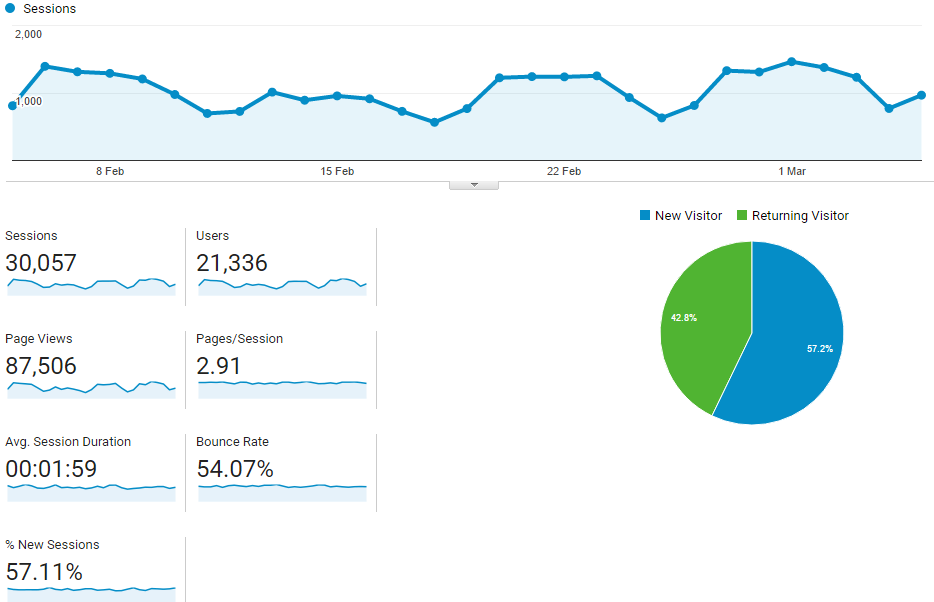
Universal Analytics example
The above are just a few of the many review items website owners who are earnest about being the best that they can be online should be actively monitoring and acting upon. Post launch of your website, just one or two of these items can seriously impair a website’s performance. It’s such a shame to see website failure or significant underperformance when such blocking errors are not spotted and the owners are unaware of how much they could get from their investment.
“be the best that you can be online”
The business message here is find someone to look after the health of your website and manage its performance.
About the Author
Simon Thomas is the lead partner at Toucan Internet LLP who have provided progressive web development and online marketing resources to clients since 1997. Simon also has 20 years direct marketing experience pre-internet and provides a unique blend of innovative advice based on experience and an informed understanding of today’s and tomorrow’s technologies.